
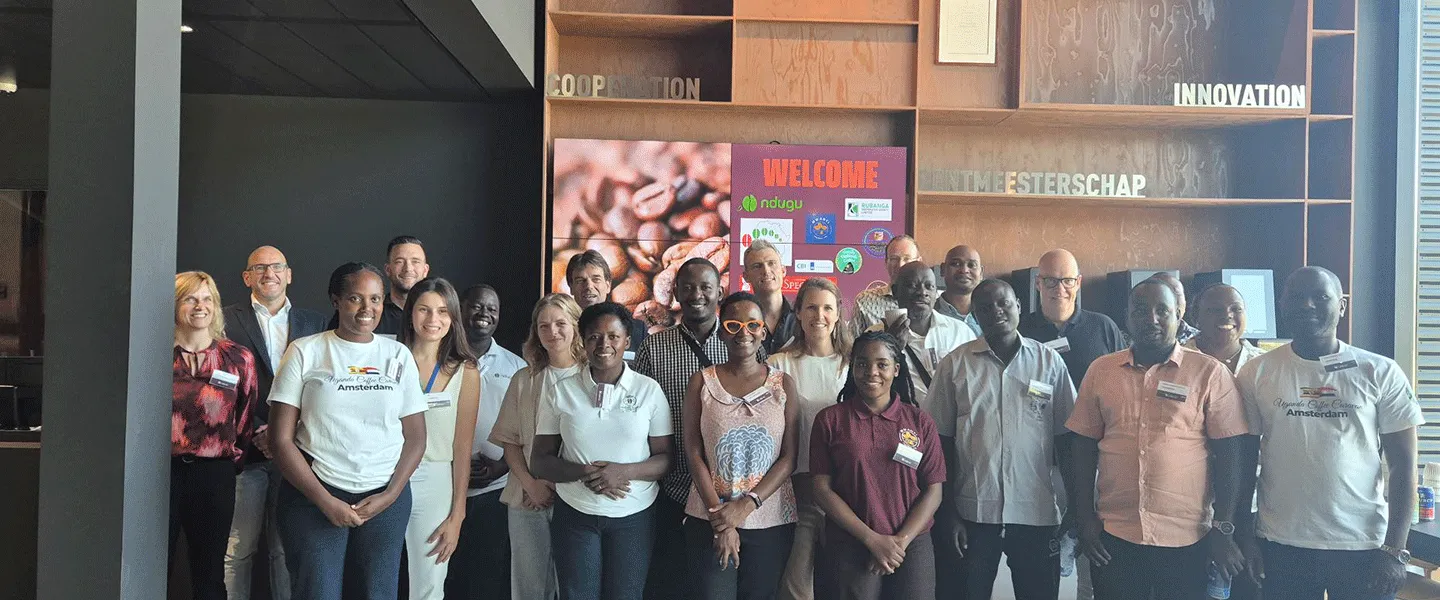
From Plantation to Cup: Ugandan Delegation Visits de Jong DUKE

Uganda: A Coffee-Producing Nation with Ambition
What happens to coffee after it leaves the plantation? To answer that question, a Ugandan delegation from the coffee sector visited de Jong DUKE in Sliedrecht. It was a day filled with knowledge sharing, surprising insights, and conversations that connected every link in the coffee value chain from start to finish.
Getting to Know de Jong DUKE
Recently, we welcomed a unique delegation of seven medium-sized coffee exporters from Uganda to de Jong DUKE in Sliedrecht: Banyankole Coffee Services Cooperative Society Fine and Speciality Gorilla Highlands Coffee Mwanyi Terimba Limited Ndugu Farmers Ltd Nyamirima Mutegaya Cooperative Society Rubanga Cooperative Society Limited. This group of coffee sector representatives is traveling throughout Europe as part of the Climate-smart Coffee Uganda program—an initiative of CBI (Centre for the Promotion of Imports from Developing Countries), Café Africa and the Oegandese Ministry of Agriculture
The visit was entirely focused on building connections: between origin and end product, between farmers and technology, and between sustainability and innovation.
The Strength of Ugandan Coffee
Uganda is one of the world's leading coffee-producing countries, with millions of smallholder farmers working every day to produce a beverage enjoyed around the globe. At the same time, the sector faces major challenges, including climate change and increasingly stringent European regulations regarding sustainability and traceability.
Surprising Insights into Coffee Consumption
One striking fact is that coffee consumption within Uganda itself remains relatively low. During the discussions, the delegation explained that currently only about 10% of the country's coffee production is consumed locally. At the same time, a clear shift is taking place, creating growing opportunities for both the local and regional coffee markets. The Ugandan coffee sector is actively working to encourage coffee consumption within the country and to increase appreciation for its own product. This contributes not only to the development of a stronger and more stable domestic market but also to greater pride in Uganda’s national coffee production.
This development aligns with a broader trend visible across many African countries. Coffee consumption is growing rapidly, driven by an expanding middle class, increasing urbanization, ongoing globalization, and a very young population. As a result, a growing group of consumers is embracing coffee as part of a modern lifestyle. For coffee-producing countries such as Uganda, this presents exciting opportunities to build a strong local and regional market alongside their export activities.
Presentations and Knowledge Exchange
During the visit, we introduced the delegation to the world of de Jong DUKE. Through a series of presentations, we provided detailed insights into our coffee machines, the technology behind them, and the way our products are designed and manufactured. The group showed great interest throughout the day. They listened attentively, and an open dialogue quickly developed, with many questions being asked. From technical details to production processes and market expectations, their curiosity and engagement were evident.
From Technology to Practice: A Valuable Learning Experience
In addition to discussions about technology and product development, it was often the practical differences that made the strongest impression. For example, our visitors found it remarkable that coffee machines in the Netherlands can simply be connected to tap water. In many parts of Africa, water must first be filtered before it is suitable for use. Insights like these led to valuable conversations about local conditions, infrastructure, and how solutions can vary from one region to another.
A Look at the Final Stage of the Coffee Journey
The visit provided the delegation with a unique perspective on the final link in the coffee value chain: the moment coffee is actually brewed and consumed. For de Jong DUKE, it was equally special to engage with representatives from the country where a significant portion of the world's coffee originates.
Building the Future of Coffee Together
Above all, the day demonstrated the importance of collaboration. By sharing knowledge and gaining a deeper understanding of one another, we can help create a stronger and fairer coffee value chain. For the Ugandan delegation, the visit offered valuable insights into the European market and coffee technology. For de Jong DUKE, it was an inspiring opportunity to connect with the origins of coffee and contribute to a more sustainable future for the sector.
In short, it was a day filled with knowledge exchange, new perspectives, and meaningful connections—from coffee plantation to coffee machine.